

Over the past few months, I have had the good fortune of sharing coffee with a few owners of privately held groups across the region. These enterprises were built patiently over several decades.
Today they carry household names, loyal teams and long relationships with principals around the world. The conversations I had were warm and candid, and they told me a great deal. Each began with pride in what had been achieved. Nearly every one ended with the same quiet question. If the business has done so well without a board, why change the formula now?
It is a fair question, and it deserves an honest answer. For much of the past several decades, the regional distribution model worked beautifully. A family house secured agency rights for international brands, built warehouses and fleets, and looked after its wholesalers and retailers. It also used the region’s position as a trading crossroads to re-export into Africa, Central Asia and the subcontinent. Margins were healthy, and principals relied on the distributor’s market knowledge. The founder’s personal network was the most valuable asset the business had, even though it appeared on no balance sheet. Decisions were made quickly around one table, often by one person, and that speed was a real competitive advantage.
That world has shifted beneath our feet. Modern trade has consolidated, and quick commerce, marketplaces and social selling now compete with the hypermarket. B2B buyers compare prices on platforms rather than through salesmen. Sanctions, freight disruptions and changing tariffs have reshaped the re-export routes. Inflation squeezes margins from both ends. Principals push for volume, while retailers demand higher listing fees and longer credit. Most significantly, brands have learned they can reach consumers directly. They now collect the data, shape the pricing and own the customer relationship that once belonged to the distributor.
Many of the first-generation owners I met are now in their late sixties, seventies and even eighties, and they admit this openly. They speak of slowing down and of finding the geopolitical landscape harder to read. They mention the bewildering pace of digital channels and the lack of a clear successor, whether within the family or among professional managers. Yet the same conversations reveal deep apprehension. They fear that a board, especially one with outsiders, may disturb delicate family relationships, weaken control and add cost without adding visible value in the short to medium term. These concerns come from culture, from honour and from a lifetime of trusting one’s own judgment. Certainly, these concerns deserve respect, not dismissal.
The answer lies not in any board but in the right board. A few seasoned professionals can be transformative if they have worked in the region and understand the unspoken codes of family enterprise. They must know when to speak in the boardroom and when to speak privately with the patriarch.
Such directors do not take power from the founder, and reserved matters can stay firmly with the Chair and the family. What they bring is independent judgment, structured strategy, disciplined investment decisions, credible financial reporting and a succession pipeline that does not depend on chance. A clear monthly dashboard gives the Chair full visibility without daily involvement and frees the CEO to move with confidence.
Examples from around the world are persuasive. At company I have studied in detail, the family Chair concentrates on long-term direction while professional management runs the business. The group appointed its first non-family chief executive some years ago. A confectionery brand, family-owned for more than a century, completed its major acquisition of another brand under a non-family CEO. Closer to home, a reputed local group has equal numbers of family and independent directors on its board, supported by audit, risk and people committees. None of these families lost control. Each multiplied the value of what it controls.
This matters because the opportunity ahead may be unlike anything the region has seen. Once the present uncertainties settle, population growth, infrastructure investment, tourism, new logistics corridors and capital market reform could combine into what economists call “hockey stick” growth. Capturing it will demand capital, technology, talent and partnerships on a scale that few single entities can generate organically. Groups with professional governance will be the ones ready to consider either an IPO, or welcome a strategic or sovereign investor, or join with regional peers to create real synergies. Investors do not buy relationships. They buy transparency, systems and predictable stewardship.
The pitfalls are real and should also be named. A board appointed for appearance rather than substance becomes an expensive ornament. Directors who do not understand family dynamics can create friction. A family that invites independent views only to overrule them will soon lose good people. A board must be designed with care, with clear charters, defined decision rights and a Chair who is willing to listen.
The greater risk, however, is standing still. Brands from China, India and elsewhere may keep going direct. Or they may reduce distribution houses to fulfilment partners who are ending up becoming financers who fund buying of inventory and giving market credit, while brands will keep strategy, marketing and pricing for themselves. Either way, the value of agencies built over decades could erode quietly, and then suddenly. The distributor becomes a warehouse with a fleet, competing on cost and renewing contract by contract, with little stake in the brands it helped build.
From a stewardship perspective, the question is no longer whether a successful family business needs a board. It is whether the founder’s legacy deserves the protection, perspective and preparation that only a thoughtful board can provide. The founders built something remarkable. The finest tribute to that achievement is to make sure it outgrows them and lasts for the generations who will inherit it.
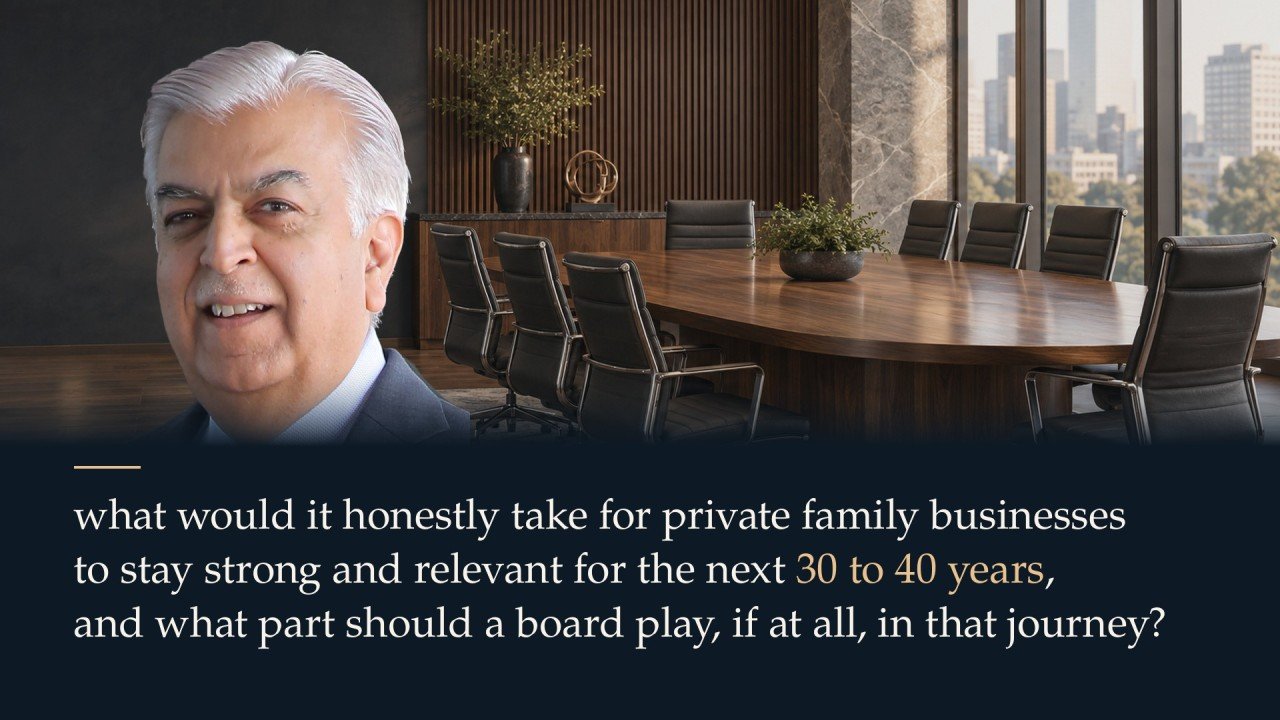
Founders, family members and CXOs: what would it honestly take for your family businesses to stay strong and relevant for the next 30 to 40 years, and what part should a board play, if at all, in that journey?
