

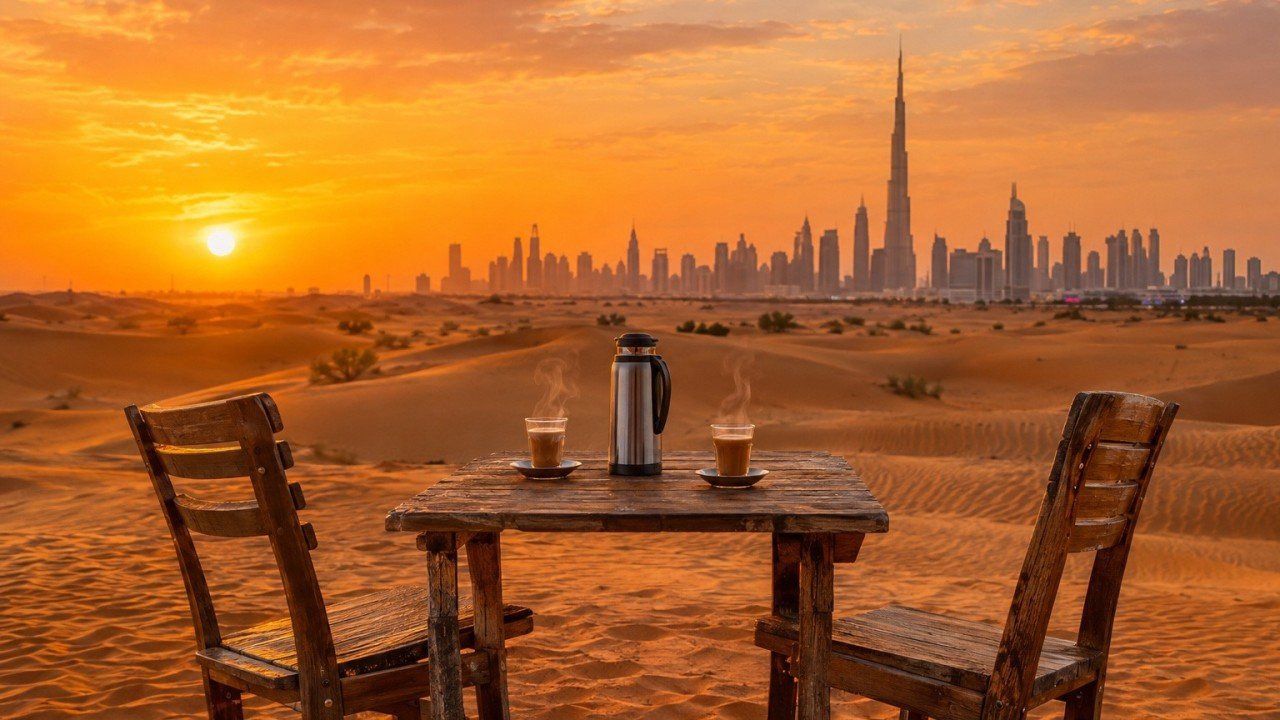
(The pic for the article has been created by AI, to reinforce the spirit of inclusivity and tolerance that the city and the nation exhibit)
For the senior director and former CEO who has called Dubai home for more than thirty-four years, one image has always captured the city.
A neighbourhood karak counter late at night. Delivery riders take a break on plastic chairs, expatriate friends chat in three languages, and a local in a pristine white kandura leans from a luxury SUV to honk for curbside service. An executive and a delivery rider enjoying the same modest pleasure, in the same space, at the same hour.
This senior director has sat in many boardrooms, but he has never seen governance, diversity and quiet confidence expressed as perfectly as in this single scene.
When he first arrived, more than three decades ago, Dubai was a smaller, already ambitious trading city strung along a Creek, where wooden dhows still do business a short drive from what would become the tallest building on Earth. Over the decades he watched the skyline rise, and something rarer rise with it. A home, within a country, with some 200 nationalities, where people do not merely tolerate one another but co-create a shared culture.
Mosques, churches, temples and gurdwaras sharing the same air, the call to prayer echoing against futurist glass.
And beneath it all, an everyday efficiency many take for granted. A Metro where a worker, an executive and an Emirati family share the same carriage. Services that simply function, streets where a midnight walk is safe and secure. Safety, he learned, is not a statistic. It is a baseline of trust. He could vouch for it since he did his morning walks at 4 30 am, five days a week, for the past 20 years.
It was never a straight climb. He lived through the Russian rouble devaluation, the currency crisis, the 2009 debt crisis when sceptics wrote the city’s obituary, through the oil-price collapse that battered the region, through a pandemic that emptied the airports of the world’s busiest crossroads. What impressed him was the recurring determination to adapt and rebuild. By 2023, Dubai International had surpassed its pre-pandemic traffic with 86.9 million passengers, and the city had welcomed a record 17.15 million international overnight visitors, above even its pre-COVID benchmark.
What he remembers most, though, is the people who delivered those rebuilds. In April 2024, when a year’s rain fell in a single day, residents of a tower on Dubai’s Sheikh Zayed Road organised themselves through a WhatsApp group to bring food, water and battery packs to stranded motorists, so they could recharge their phones and reassure their families.
Elsewhere in the city, neighbours used kayaks to evacuate families from flooded homes and opened their own houses to shelter them.
During COVID-19, the “Your City Needs You” campaign drew 12,230 volunteers from 40 nationalities who distributed half a million free meals through the old districts of the city. He remembers creating an “Angels” team in his company, a team that worked 24×7 to meet the needs and requirements of the company employees during that period.
That, he tells younger directors, is what resilience actually looks like. Not concrete, but people.
Today the city is caught in a crossfire not of its making. A regional war that escalated in late February closed skies, rerouted shipping and emptied hotel rooms. He knew that success could provoke envy, and that there would always be those who bad-mouth what they cannot replicate. But stewardship, he believed, also meant telling the difference between reflexive disparagement and criticism worth hearing. Dubai responded as it always had, with a substantial government support package for its hardest-hit sectors. This test was still unfolding, and his confidence rested not on immunity from shocks, but on the capacity to respond.
From a board governance perspective, he believes every director could study this city. What is Dubai, he asks, if not the ultimate case in long-term good governance and stewardship? A leadership that plans in decades, not quarters. Diversification treated as portfolio strategy of trade, logistics, tourism, finance, technology, thereby reducing dependence on any single sector. Crisis decision-making that pairs speed with accountability, and failures that become lessons rather than alibis. And, above all, an intangible asset that never appears on any balance sheet. Mutual respect, the social glue that holds such a diverse community together. Boards obsess over strategy and risk. This city’s deepest lesson is that values are the asset that compound fastest and erode silently if neglected.
The alert areas are real. Guarding tolerance and social cohesion against complacency. The rulership and the government are doing more than their share. The common resident too has to play their part for the tango dance to work well. Affordability for the middle class that keeps the city’s soul. The truest barometer, he says, is how the city treats its service and blue-collar workers, and it’s middle class.
But he does not dwell on the warnings. He thinks instead of the karak counter. Cardamom on the night air, a dozen languages around him, the skyline glowing in the distance. More than thirty-four years ago, he had come looking for opportunity. He found a home in a city that scales the heights of modernity without ever losing the warmth of a majlis. Empires of glass and steel, he reflects, are built everywhere. But a city where an executive and a delivery rider share the same cup of tea, at midnight, and that too in safety. Having got the opportunity to travel to over 62 countries, he can vouch for the fact that the Dubai and UAE model is built on something rarer.
Dubai’s skyline is its photograph. Its people and its culture are its soul. And both, he is certain, are still improving, and rising.
His deepest prayer for Dubai, the UAE, and India (his country of birth) was not that their skylines would rise forever, which they will, but that beneath them, people would always find safety, dignity and one another. May this nation, and his country of birth, which gave so many a place in the world, remain protected, peaceful and a home to hope, always.
