

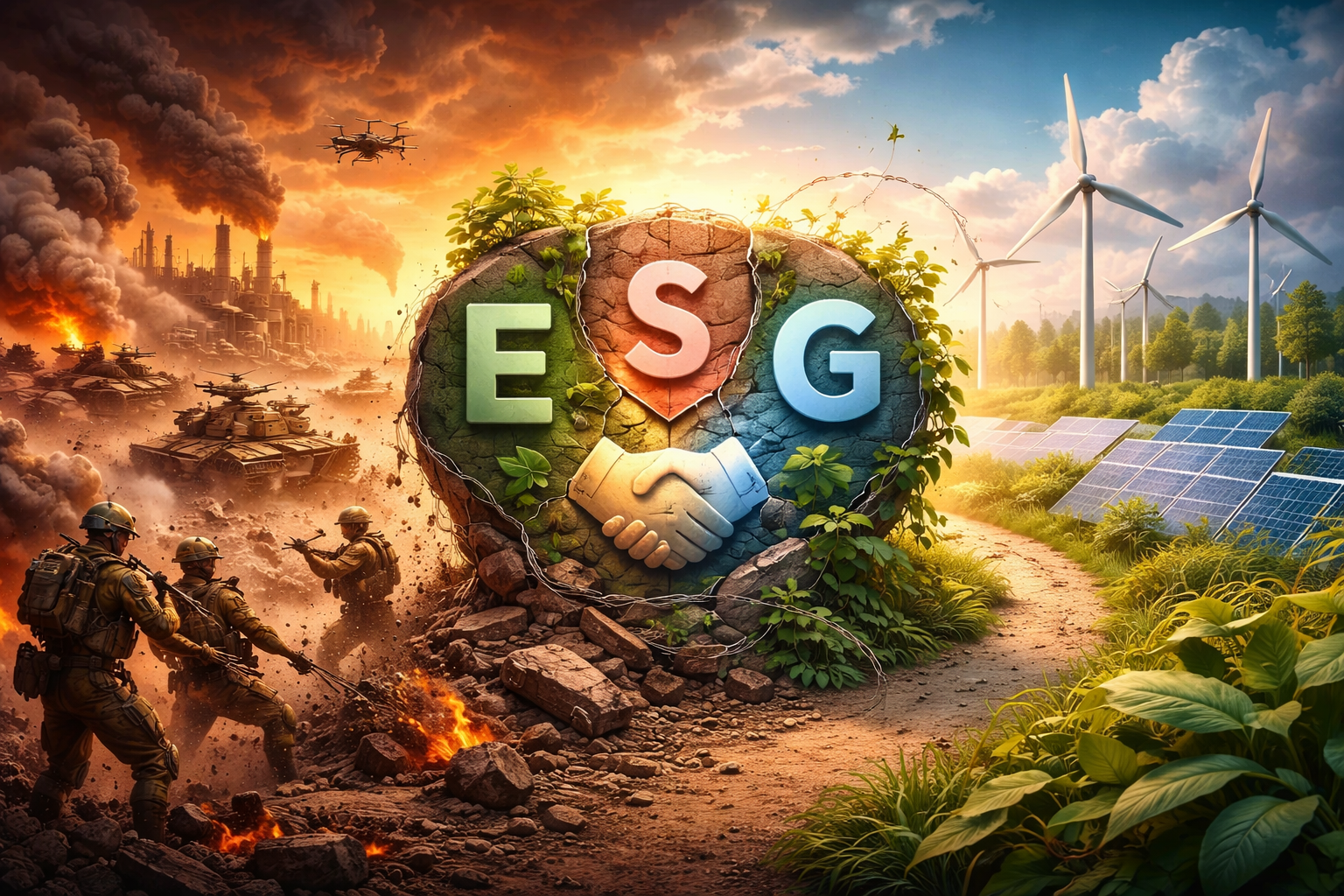
In the shadowed valleys of a fractured world, an Indian origin governance expert and director on few boards, gazed at satellite images of scorched earth from one part of the world to the other, his heart heavy with the irony of humanity’s dual path.
One path moving towards planetary salvation via ESG, and the other dragged back by ceaseless wars. ESG, the triad of Environmental stewardship, Social equity, and Governance integrity, stands as our planet’s lifeline, curbing emissions, fostering justice, and ensuring ethical leadership amid climate peril. Yet, as nations clash in over several dozen armed conflicts which have doubled in a decade, these skirmishes are systematically eroding every ESG pillar, threatening to offset fragile gains in renewables and rights.
This director, who was recently trained by an ESG Guru, traced a grim pattern in his mind. Nation-states are wielding weapons to dismantle rivals, from one country’s hybrid assaults on Europe to another country’s civil carnage, and several potential flares in different regions of Asia.
The Environmental (E) toll is staggering. Militaries supposedly emit 2,750 million tons of CO2e yearly. This is 5.5% of global GHGs. In the case of one particular war alone, which has been going on for few years, the serious contamination of soil and waters is a daily feature. Another conflict has viciously damaged more than 70% of infrastructure, polluted 95% of water, and razed 80% of croplands. Per day, conflicts like these are inflicting environmental havoc equivalent to thousands of tons in emissions and toxins, reversing decarbonization as fossil fuels surge for “security.”
Socially (S), the devastation strikes women and children hardest. Physical wounds from blasts scar bodies, while abuse, malnutrition and disease ravage the young. Mentally, PTSD haunts sleepless nights, breeding anxiety and despair. Emotionally, orphaned children cling to trauma, and mothers grieve lost futures amid displacement. Several million have been displaced, shattering labor rights and human dignity.
Governance (G) crumbles under corruption and opacity in war zones.
These skirmishes spawn a vicious cycle, where short-term victories sow long-term ruin and even more hatred. The director reflected on how proxy wars and resource grabs over rare earths, whether in Africa or Arctic routes, have fueled escalation, as superpowers arm proxies without direct accountability, prolonging agony and amplifying ESG reversals.
Investors, who were once ESG champions, now have pivoted to defense stocks surging 30% amid tensions, diluting sustainable portfolios while boards grapple with “greenhushing” to dodge political ire.
Rebuilding razed cities devours decades and trillions. Giving birth to a perverse cycle where destruction fuels reconstruction contracts, turning carnage into a business model for arms and aid industries. Energy itself weaponizes. Pipelines rupture, sanctions choke supplies, and directed-energy weapons emerge, mirroring how three-quarters water-covered Earth now sells bottled H2O. Is air monetization on the way as pollution worsens?
The director pondered if this endless loop of destroy, rebuild, repeat has become a strategy that profits a few at Earth’s expense, questioning when collective sanity will prevail over profit-driven mandates.
For boards governing and stewarding weapons firms, lessons cut deep. How do they work their year-on-year growth strategies? With what face can these manufacturers divert profits to CSR, lauding schools, wells or hospitals built on blood money? It mocks ESG’s soul, whitewashing destruction while fueling the very harms social goals seek to heal, defeating holistic integrity. True stewardship demands pivoting to defensive tech for peace. Drones for aid, not assault. Aligning growth with humanity’s higher call.
The director turned to mythology for solace. In Hindu mythology, Kali dances on battlefields, her frenzy birthing renewal from chaos, slaying ego-driven demons whose blood spawned more foes, mirroring skirmishes where destruction begets destruction. From Norse sagas, Ragnarök looms as gods clash in apocalyptic fury, yet from the ashes, a new world sprouts as Baldr’s return heralds peace if humanity heeds the cycle’s wisdom, choosing harmony over endless strife. Greek tales of Ares, god of war, clashing with Athena’s wisdom, warn that blind fury devours all.
Yet how can different nations invoke the same Supreme Being to annihilate or destroy another race? Almost the entire world realizes that in the understanding of one supreme being, no hierarchy exists. One divine essence binds humanity. “Tat Tvam Asi” from the Hindu Upanishads and “Kun Fayakun” from the Quran share profound spiritual similarities, both pointing to the non-dual unity of the divine and the self, though they arise from distinct traditions. Both urge recognizing shared sanctity over strife, fostering sanity as mentors to the next generation. The same goes for other religions as well.
As dawn broke over the skyline, the Director envisioned stewards rising. Boards embedding peace in growth plans, leaders invoking shared divinity to halt the dance. Conflicts wane not by arms, but by wisdom. ESG as shield, not sword. In this potential, Earth breathes free. Ultimately, if we are to be coaches, guides, and mentors to the new generation, we must desperately find a better way for sanity to exist, teaching resilience through unity, not rivalry, so tomorrow’s leaders inherit a world healed, not haunted.
This paragraph below has been borrowed from what was read on the internet and forwarded by a friend……
“War has become a place where young people who do not know each other and do not hate each other kill each other, by the decision of old people who know each other and hate each other, but do not kill each other”.
“Peace is the only battle worth waging.”—Albert Camus
Some of the Director’s friends would say – all this is too Utopian in thinking. The Director decided to leave it to
