

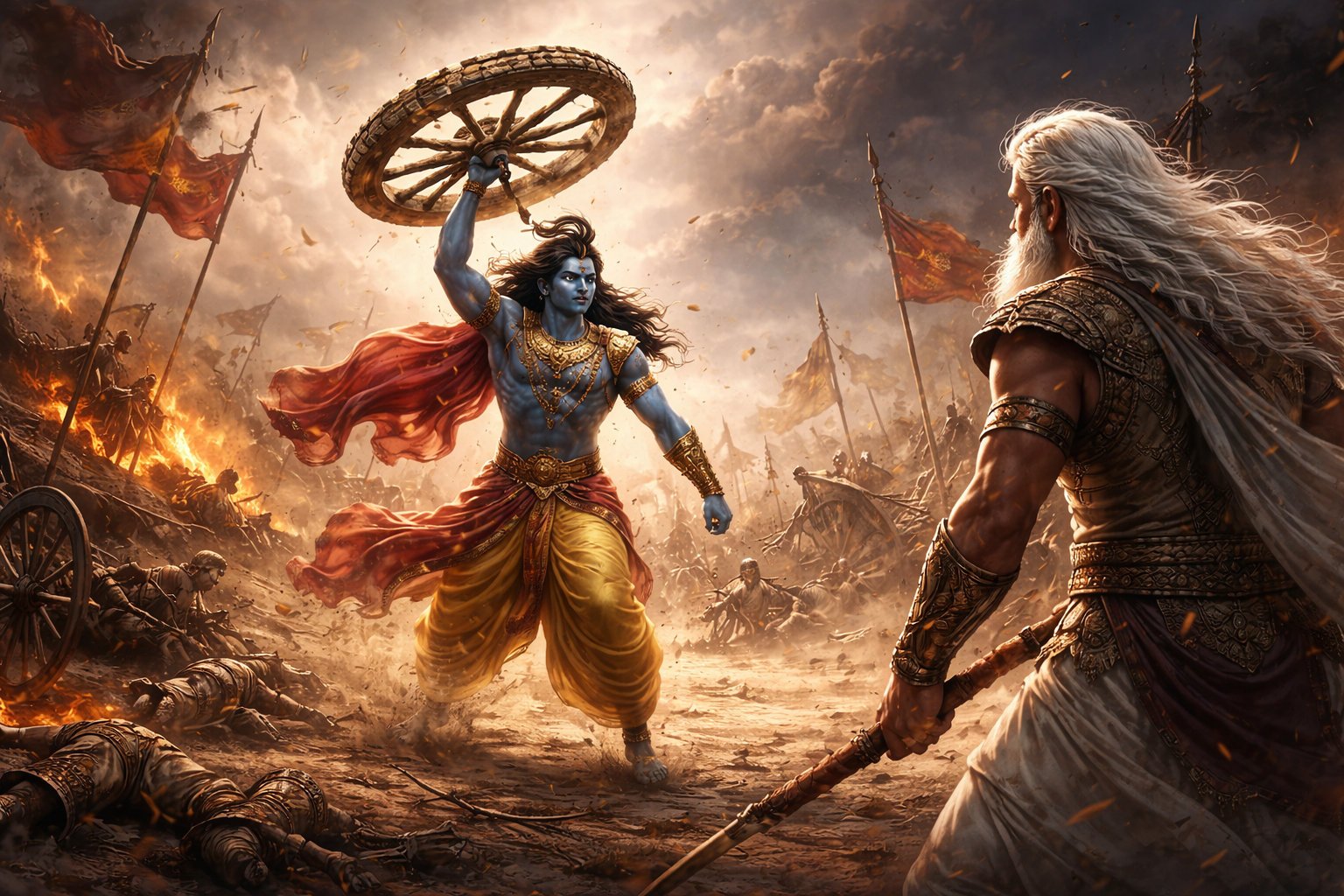
On the blood-soaked field of Kurukshetra, Krishna’s hand on a discarded chariot wheel became more powerful than any scripture, because in that single act he showed that a rule is sacred only when it protects the truth. Bhishma did not see a broken promise. Instead he saw a prison door opening.
Both Krishna and Bhishma stood inside their vows. Krishna had promised not to lift a weapon. Bhishma had promised lifelong loyalty to the throne he had sworn to protect. As Bhishma’s arrows tore through the Pandava army with cold precision, the war’s purpose was quietly being defeated. Adharma was surviving under the shelter of noble promises.
Krishna watched with concern, not ego. The war was not about maintaining personal honour. The war was about restoring balance and justice. When a vow began to protect injustice instead of truth, he stepped down from the chariot, lifted a broken wheel, and surged towards Bhishma, willing to let his own promise bend so that dharma could stand.
In that instant, Krishna was teaching that rules are tools, not masters. A rule is worthy only as long as it serves what is right. When it blocks what is right, it becomes a burden, even a cage. Bhishma realised that his lifelong loyalty to a structure, the throne, the dynasty, the vow, was now helping chaos continue, not order.
Dharma, then, is not blind obedience to yesterday’s decisions. Dharma is intelligent response to what is real today. Sometimes dharma coincides with a rule, and yet sometimes it asks one to step beyond it, not out of rebellion but out of a deeper responsibility to truth.
Think of a red traffic light. The rule says “stop”. This maintains order, reduces accidents, and protects life. But if an ambulance with a critical patient is behind one’s car, the same rule must bend to a higher value. Saving a life. One does not cross the red signal because one is careless. The red signal is crossed because something more sacred is at stake.
Krishna’s vow was the red light. Bhishma’s unstoppable assault, threatening to crush the very cause of justice, was the ambulance. To stand still in that moment would be obedience to a promise but betrayal of dharma. So he moved. Bhishma did not feel insulted. He lowered his bow in understanding, seeing that no rule is higher than truth.
Dharma, Loyalty and Corporate Governance
Good governance in organisations faces the same paradox. Whether to cling to rules or to serve the larger purpose they were meant to protect. Modern thinking already distinguishes rules-based governance (strict checklists, rigid compliance) from principles-based governance (judgment guided by purpose and values). Krishna’s act sits firmly in the second camp. Being loyal to the purpose, not to the structure.
In corporate life, this matters deeply. Loyalty to purpose, not to a person or position. A board member who hides misconduct to “protect the company’s image” is Bhishma defending the throne while injustice spreads. True stewardship protects long-term fairness, transparency and stakeholder trust, even when it means challenging powerful insiders.
Rules are made to protect truth, not to hide it. Policies, codes and procedures are necessary, but when they become shields to avoid hard questions, they turn into sophisticated cages. Governance fails when form is preserved and substance is sacrificed. How often do we hear “We followed the process, so we are safe”. Intelligent responses are a must over mechanical compliance. Principle-based governance expects directors and executives to exercise judgment by asking, “What is the right outcome for stakeholders, for society, for the long term?” rather than “How do we tick this box?” This is Krishna looking at the result, not just the rule.
Good governance, like Krishna on that battlefield, keeps asking “What was this rule created to protect?” If it protects truth, keep it. If it hides the truth, change it. Boards that grasp this stop treating policies as walls and start treating them as railings which are supportive but not allowed to block necessary movement.
The silent dialogue between the raised wheel and the lowered bow carries a message for every society, every boardroom, every individual conscience. Do not hide behind promises, habits, or structures if they now serve only to keep one blind. Let loyalty be guided by broader understanding, so it never hardens into stubbornness.
Dharma is not a frozen script, it is living awareness. Rules can tell one where to walk, but awareness shows one where to step. When one remains loyal to the purpose of truth rather than to any single form it once took, one steps out of the cage Bhishma discovered and into the freedom Krishna was pointing to. A higher ethics where courage, clarity and compassion are more important than being legally correct and never breaking a rule.
