

It was the summer of 1992 in Dubai, a time when the city still hummed softly, its skyline modest, its rhythms slower. Inside the newly emerging Jebel Ali Free Zone, the afternoon sun pressed against glass windows as workers moved quietly through the corridors. The air smelled faintly of sand and sea, and the world felt simpler, driven by ambition, yes, but wrapped in a kind of communal courtesy that blurred the boundaries between strangers.
It was Ramadan.
The head of one company had gone for lunch to one of the few restaurants that were available those days in the freezone. After finishing lunch, he came out of the restaurant munching on a packet of chips. From the opposite side of the road, a cop car saw him, took a u-turn and came back. The officer lowered his window. His face carried neither anger nor authority, only firm politeness. “Sir,” he said with quiet respect, “it’s Ramadan.”
The man froze, realizing the slip. He had not meant any harm, only forgotten the hour, caught between work, lunch and habit. But the look in the officer’s eyes was enough. It wasn’t a stern warning, just a reminder, a soft hand placed on tradition. Apologies were exchanged, smiles followed, and the moment passed.
Yet something lingered long after. The lesson that living in Dubai meant sharing not just its streets but its spirit.
That was how Ramadan felt in those early years, like a city in pause. The change in rhythm was visible everywhere. Restaurants covered their windows with white drapes. The scent of food stayed quietly behind doors until sunset. The roads seemed less hurried, the voices softer. Even laughter sounded restrained, out of respect for those fasting.
There was an unspoken empathy that threaded its way through offices, malls, and construction sites. Whether one fasted or not hardly mattered. Everyone, in some small way, participated in the discipline of restraint. A sip of water was taken behind closed blinds. Meetings were scheduled with sensitivity. Voices lowered at noon and rose again with the call to prayer.
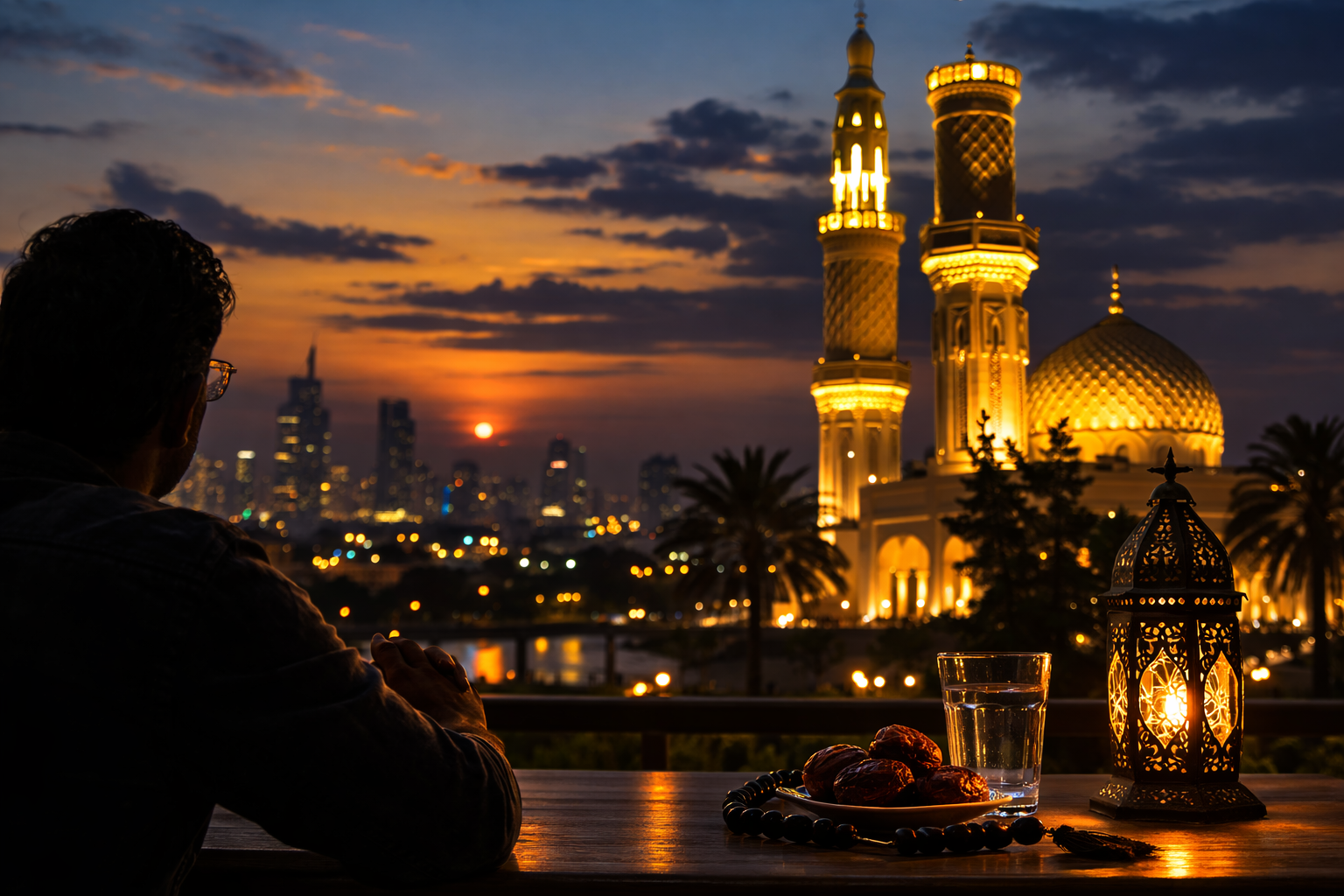
And when the cannon signaled the breaking of the fast at Maghrib, the city exhaled together. From Deira to Jebel Ali, lights awakened, aromas of cardamom and dates filled the air, and mosques glowed like beacons. It wasn’t merely ritual. It was rhythm, one that drew even non-Muslims into its warmth.
Over the years, that rhythm embedded itself in countless lives. For many who came from distant lands, Ramadan was not just observed but felt. Even those who had grown up with different customs found themselves drawn to its quiet strength.
This head of company, who by now had become de-facto CEO, began fasting twice a week during the month, not out of obligation but participation. It became his own form of respect, a symbolic joining of souls, a practice which continues till date. The hunger didn’t matter much. What mattered was the silence, the intentional slowing down of thought. During those fasting days, even the smallest act, greeting a colleague or pouring a glass of water, carried mindfulness.
He often received invitations to evening Iftars, long tables lined with silver trays, laughter, and steaming biryani. He would go, most of the times with embarrassment and hesitation. Sitting among those who had kept the day’s fast, he felt a mix of gratitude and humility. He hadn’t endured what they had, yet he was always welcomed as if he had. That inclusion, gentle and unspoken, was perhaps the essence of Ramadan in that Dubai. It wasn’t about religion, it was always about reverence.
Today, that same city carries a new face. Towers touch the horizon, roads gleam under automated lights, and the air hums with languages from every corner of the world. Freedom walks easily through its streets. During Ramadan, cafés stay open, delivery riders move without pause, and people drink their morning coffee on park benches without fear of reproach.
It’s progress, a reflection of global openness, tolerance, and inclusion. A person can be themselves, publicly, comfortably, without transgression. The city no longer enforces reverence, it trusts awareness.
And yet, for those who remember the older rhythm, like this ex-CEO, something still feels quieter in memory. The collective silence that once blanketed Dubai during daylight hours, has thinned. The sense of shared stillness, Muslims and non-Muslims alike moving in careful harmony, has softened into personal choice.
Change for good also brings its own paradox. The Dubai of today celebrates coexistence. The Dubai of yesterday taught deeper reflection.
The truth is that reverence never required rules. It simply needed recognition. Ramadan’s essence has never been about who eats and who fasts, but about who remembers to pause, to reflect, to feel the hunger of empathy.
In the early days, the city reminded its people. Now, it trusts them to remind themselves. The shift is neither loss nor gain, it is evolution. The sacred veil remains, thinner perhaps, but still shimmering if one knows how to look.
As dusk falls, the city today still glows under strings of golden light. The call to prayer still ripples through glass and steel, finding its way into homes, offices, and moving cars. And somewhere, the one who came to this city 34 years ago, quietly sets aside a bottle of water, waits a little longer, and smiles.
Because some good habits, once learned from respect, never easily leave.
