


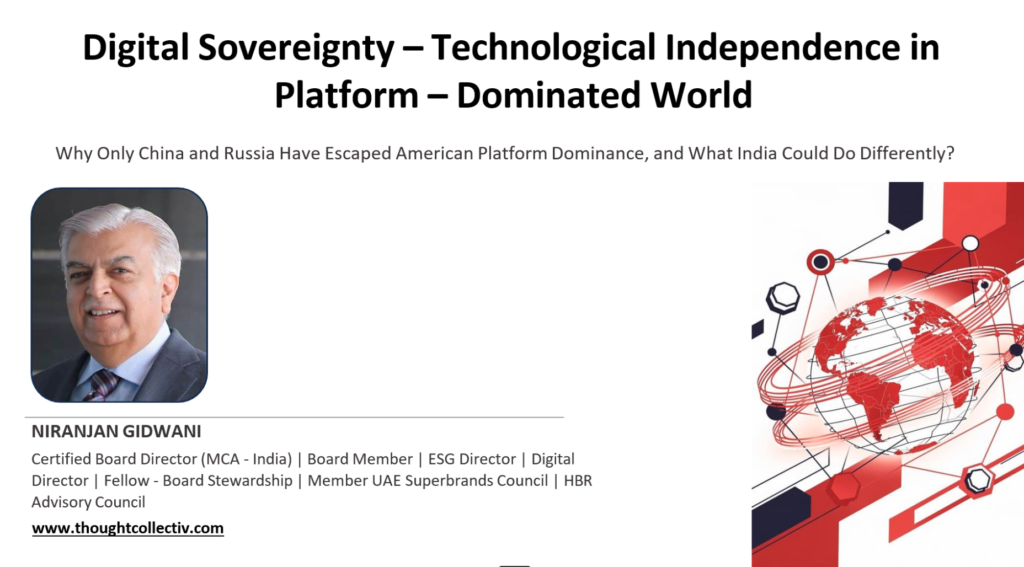


🎯 Digital sovereignty refers to a nation’s ability to achieve technological independence amid U.S. platform dominance. I have been very keen to understand how India will move in this regard. So i did a deeper study of how things stand now, and created a presentation.
🎯 Besides USA, so far, only China and Russia have succeeded among major economies.
🎯 What did China and Russia do? These countries leveraged political triggers.
🎯 China’s Great Firewall post-2009 and Russia’s linguistic barriers plus 2019 laws and 2022 sanctions.
🎯 These helped to build domestic stacks like WeChat, Yandex, and Mir payments, fostering scale in large home markets while preventing foreign acquisitions.
🎯 Unlike India and Europe where openness enabled U.S. acquisitions (e.g., Flipkart by Walmart) and regulatory efforts like GDPR failed to create champions due to fragmentation, capital scarcity, and talent drain.
🎯 India, despite its engineering talent and UPI success as a public-good blueprint, has been allowing U.S. platforms early dominance and brain drain to Silicon Valley, but holds potential through expanding “India Stack” (Aadhaar, credit APIs), sovereign AI funds, procurement mandates, golden shares in key firms, and language-specific AI to counter U.S. advantages.
🎯 So what role do Boards need to play? Boards must treat tech dependence as existential risk, prioritizing sovereignty via multi-cloud strategies, data localization, and domestic partnerships, especially as AI, quantum, and 6G bifurcate into U.S.-China spheres, urging multi-track paths.
🎯 State-built infrastructure, selective barriers, talent retention, and regional alliances may be needed for the Global South to become a key player.
🎯 This synopsis presentation captures the core thesis on U.S. dominance origins, China/Russia successes, India/Europe gaps, governance imperatives, and actionable roadmaps, aligned with broader analyses emphasizing some amount of protectionism’s role over pure regulation. 🎯For someone who is just getting to understand this space better, do add positive value and comments to improve our collective learning 🎯